

Liver disease is rapidly emerging as a major global health burden, with cirrhosis contributing significantly to mortality worldwide. In India alone, liver failure is estimated to cause around 250,000 deaths annually, underscoring a growing and under-recognized public health crisis.
The problem is twofold—late detection and lack of practical diagnostic tools, creating a clear need for simple, accessible alternatives.
In this context, research from an Indian doctor has gained international attention for proposing a practical, low-cost solution using routine laboratory parameters. The work focuses on commonly available indices—Neutrophil-Lymphocyte Ratio (NLR) and AST-to-Platelet Ratio Index (APRI)—derived from standard blood tests (CBC and LFT), helping to predict severity and outcomes in cirrhosis.
The findings highlight how these markers can be used for rapid assessment and risk stratification, particularly in high-volume settings where time and resources are limited.
Importantly, such tools can be deployed without additional cost or infrastructure.
For India, this is where the impact is direct. A large proportion of patients present late, often to resource-constrained hospitals managing high patient loads. In such settings, solely relying on expensive scoring systems or delayed investigations may even cost lives. These tools could allow clinicians to identify high-risk patients early, prioritize care, and make faster decisions using readily available tests, potentially improving outcomes at scale.
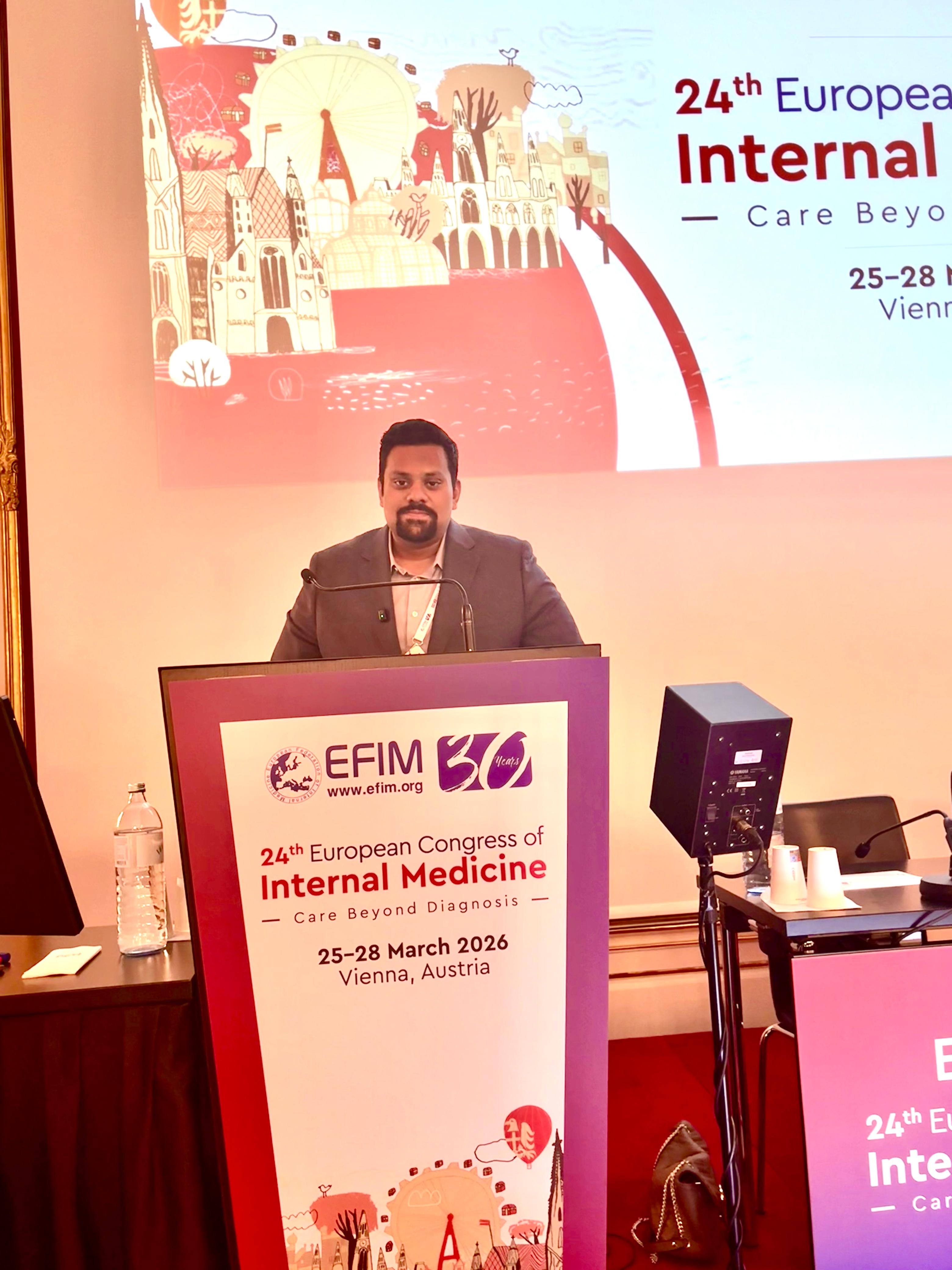
His research has been invited for a podium presentation and discussion at the 24th European Congress of Internal Medicine (ECIM 2026), held at the historic Hofburg Palace from March 25–28, 2026—a leading global platform for internal medicine.
The abstracts (Nos. 0955 & 0958), titled:
“India’s Cirrhosis Pivot”
“Inflammation Speaks: Neutrophil-Lymphocyte Ratio and AST-to-Platelet Ratio Index (APRI) Redefine Rapid, Low-Cost Prognostication for Cirrhosis in Mumbai, India”
address both the changing epidemiological landscape of cirrhosis in India and the need for accessible prognostic tools.
The researcher, Dr. Udit Bhaskar Vaish, a 27-year-old Indian doctor from Delhi and currently a Senior Resident in General Medicine at Dr. D.Y. Patil Medical College, Navi Mumbai, is part of a new generation of clinicians focusing on clinically applicable, resource-sensitive research.
Speaking on the work, he said: “Simple and accessible medical tools can make a big difference in managing serious diseases like cirrhosis, especially in resource-limited settings.”
The significance goes beyond individual recognition. It reflects a broader shift—Indian clinical research increasingly aligning with real-world healthcare needs, where scalability, cost, and speed matter as much as accuracy.
Acknowledgement
“Indian medical landscape is changing rapidly,” said Dr. Vaish. “We are seeing a seismic improvement in patients with viral cirrhosis thanks to newer government-led initiatives for antiviral rollouts; however, with the rising incidence of fatty liver and alcoholism, a quick risk stratification tool is the need of the hour. With more such tools in the arsenal of Indian doctors, our clinicians will be better equipped than ever to handle the tremendous patient load they are subjected to every day.”
